
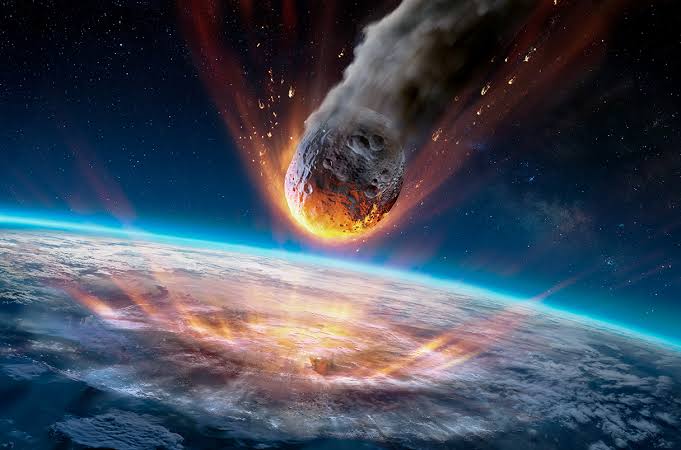
Everyone knows the dinosaurs were wiped out by an asteroid. But the real story isn’t just about the impact itself, it’s about the global climate chaos that followed.
As a child, watching films like The Land Before Time, I thought the dinosaurs died because lots of little asteroids physically rained down on them. Looking back, that was obviously nonsense, but I don’t think I’m alone in having a very hazy idea of what actually happened. The extinction of the dinosaurs is one of those events everyone knows about, but very few of us are ever properly taught. It wasn’t until university that I really appreciated the global significance of it.
So, let’s set the scene. It’s 66 million years ago. In what is now Mexico, a 10 km-wide asteroid is on a collision course with Earth. Beneath the shallow sea where it’s about to hit sits a carbonate platform and buried hydrocarbons, which, for reasons that will soon become important, is a very unfortunate place for a giant space rock to land.
When the asteroid hit, it vaporised on impact and blasted out the Chicxulub crater: roughly 180 km wide and around 20 km deep. The immediate destruction near the impact site would have been catastrophic. But the reason this event caused a mass extinction wasn’t just the explosion itself. It was what happened next.
The impact hurled vast amounts of vaporised rock, sulphur, dust and soot high into the atmosphere. Fires ignited. Sunlight was blocked out. Photosynthesis collapsed. Temperatures dropped. Food chains started to fail from the bottom up.
In other words: the asteroid didn’t just smash into Earth and kill things on contact. It triggered a rapid, global climate crisis.
This is the part of the dinosaur story that tends to get flattened into “big rock hits planet, dinosaurs die”, when in reality the real killer was the environmental collapse that followed. Once sunlight was cut off, plants and plankton struggled, herbivores lost their food source, carnivores lost theirs, and entire ecosystems unravelled. It always comes back to GCSE Biology in the end.
And as if that wasn’t enough, the impact also generated enormous tsunamis. If you’re picturing dropping a stone into a pond and watching the ripples spread, that’s not a bad starting point, except this was a 10 km asteroid travelling at around 20 km per second. The resulting waves were large enough to reshape coastlines across the planet. In the rock record, scientists have identified “mega-ripples” with wavelengths of around 600 metres and heights of roughly 16 metres, evidence of just how violent these ocean disturbances were.
The combined effects were devastating. Around 75% of species on Earth disappeared, including all non-avian dinosaurs. The Chicxulub impact marks the most recent of the “Big Five” mass extinction events in Earth’s history.
So how do we know any of this?
I’m often guilty of believing things I read online if they’re said with enough confidence. It’s a bad habit, and one I’m trying to break. So, in the interests of making sure you’re armed for the next time a pompous man in the pub tells you the dinosaurs just got hit on the head by a meteorite, here’s the geological evidence.
The impact happened right at the boundary between the Cretaceous and Paleogene periods, what geologists call the K-Pg boundary. This boundary has been recognised for over a century because there’s a dramatic change in the fossils found above and below it. But the case for an asteroid comes from the geochemical fingerprints left behind.
1. The iridium spike
At the K-Pg boundary, scientists found an unusually high concentration of iridium in a thin clay layer preserved around the world. Iridium is rare in Earth’s crust because, as a siderophile element, most of it sank into the core when the planet differentiated. So, finding a global layer enriched in iridium strongly suggests material from an extraterrestrial source.
2. Radiometric dating
Using argon-argon dating, scientists were able to date material from the Chicxulub impact to about 66 million years ago, exactly when dinosaur fossils disappear from the rock record. That timing matters a lot.
3. Shocked minerals and impact ejecta
Around the world, the K-Pg boundary contains impact ejecta: material blasted out by the collision itself. These deposits include shocked quartz and melt products that only form under the extreme pressures generated by a massive impact.
Put all of that together, and the asteroid explanation stops sounding like a fun theory and starts looking like a geological smoking gun.
But what about the Deccan Traps?
I can’t write about dinosaur extinction without mentioning one of the biggest arguments in palaeontology: the role of the Deccan Traps.
The Deccan Traps, in present-day India, were one of the largest volcanic events in Earth’s history. Around the same time as the Chicxulub impact, enormous flood basalts were erupting and releasing huge amounts of carbon dioxide and sulphur into the atmosphere. That would have meant climate swings, acid rain, ocean acidification, and a pretty miserable time to be alive even before an asteroid decided to drop in.
This is where the debate starts.
Some scientists argue that Deccan volcanism had already weakened global ecosystems before the asteroid struck, making the extinction worse. Others point out that the timing of the Chicxulub impact lines up uncannily well with the extinction itself, suggesting the asteroid was the decisive blow. There’s also a third, very geologically dramatic possibility: that the impact’s seismic energy may have intensified volcanic activity in the Deccan Traps, effectively making a bad situation even worse.
The current consensus is broadly that the asteroid was the primary driver of the mass extinction, but the Deccan Traps may have helped push ecosystems closer to the edge. Which, from the dinosaurs’ point of view, is not especially comforting.
The uncomfortable parallel
That’s most of the geoscience covered, but it’s hard to write about the end-Cretaceous world without thinking about our own.
The dinosaurs were wiped out by a sudden climate catastrophe triggered by an asteroid. We, thankfully, do not have a giant space rock heading our way. But we are creating our own version of rapid planetary change.
Climate change isn’t some abstract, far-off threat. It’s already woven into everyday life: heatwaves in the UK, floods, fires, droughts, crop failures, biodiversity loss. The difference is that the dinosaurs had no control over the forces reshaping their world. We do.
Many scientists argue that we’re now living through a sixth mass extinction, often called the Anthropocene extinction, with species disappearing far faster than the natural background rate because of habitat destruction, overexploitation and climate change. David Attenborough has been trying to warn us about this for years, usually while making us cry over melting ice caps or dying coral reefs.
So, while an asteroid may have ended the age of dinosaurs, the question for us is a little more unsettling: if rapid climate change once wiped-out life on Earth, what happens when this time the asteroid is us?


Leave a Reply