
In short, Yes.
Okay, I know this sounds completely ridiculous, but this is one of my favourite geology fun facts. Whenever someone asks what I studied, this is usually the story I tell first. Hopefully, in the next five minutes, it’ll be one of your favourite facts too.
Let’s start with a bit more context. Iceland is one of the most volcanically active places on Earth. It sits where two tectonic plates are pulling apart, while also lying above an unusually hot region of the mantle known as a mantle plume. In other words, it’s almost the perfect recipe for volcanic eruptions. Anyway, before I get too carried away with mantle convection, my point is that Iceland is a hotbed of volcanic activity and in 1783 one eruption changed the world.
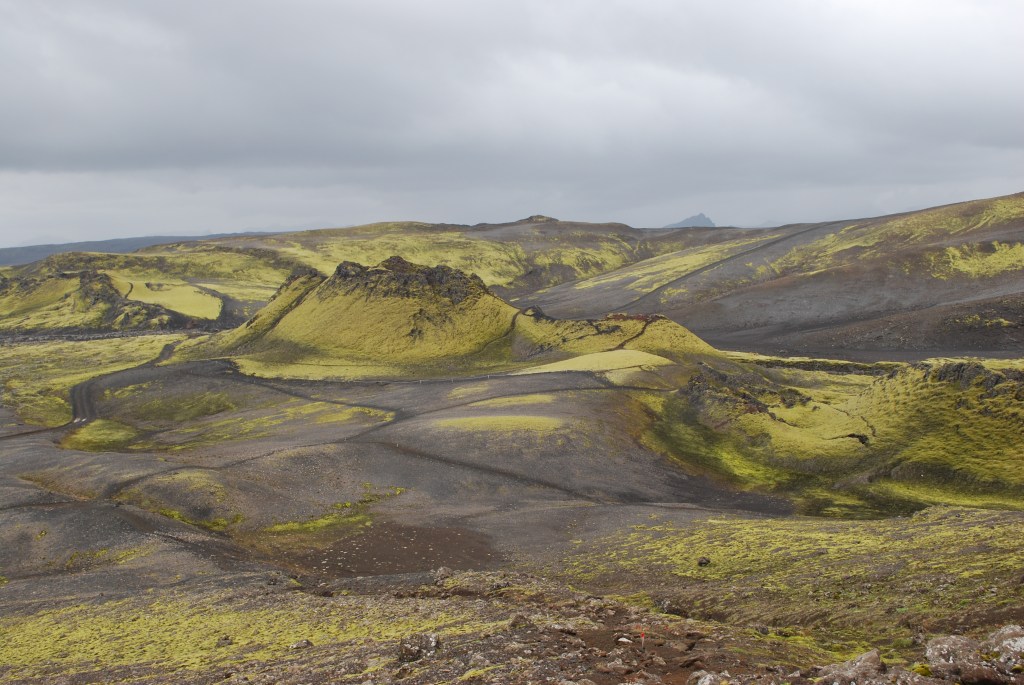
In June 1783, rising basalt magma deep underground met with groundwater and the pressure became too much. The Laki volcanic fissure opened (think of a large crack in the ground bubbling with magma) and erupted for 8 long months. In this time a chain of more than 130 volcanic vents opened across a 27km fissure. Around 42 billion tonnes of lava poured across southern Iceland while enormous quantities of sulphur dioxide were blasted into the atmosphere. The resulting dry volcanic haze spread across Europe and was even reported as far away as Syria.
When we think of dangerous volcanoes, we usually picture cone shaped eruptions like Mount Vesuvius destroying Pompeii, but the Laki eruption showed otherwise, devastating Iceland with knock-on effects across the world. It wasn’t really the lava that changed history, it was the gases. The sulphur dioxide formed tiny sulphate aerosols high in the atmosphere that reflected sunlight back into space, cooling the planet in much the same way scientists expect a large nuclear war would. This volcanic winter brought lower temperatures across the Northern Hemisphere, plunging much of Europe into a dark, sulphur-rich haze, damaging crops and contributing to acid rain.
Iceland suffered first. Around a quarter of the population died from famine after livestock and crops failed. But the eruption didn’t stop there. A dry volcanic fog spread across Europe, causing respiratory illness and crop failures. Historical records describe unusual weather from North America to Japan, while weakened African monsoons contributed to famine in Egypt.
Now what’s this got to do with the French Revolution?
I’m sure you can now appreciate the devastating and reaching impacts of this eruption on a tiny island in the North Atlantic. As I mentioned Europe was especially hit badly resulting in crop failures, respiratory diseases and extreme famine. Now I’m not saying the revolution was single handedly caused by this volcano, that would be insane, a revolution is always a culmination of lots of different things, but every revolution does need its spark. 🌋
The eagle eyed among you might be thinking that the French revolution didn’t start until 1787, this is true, but France was already walking a political tightrope. The monarchy was drowning in debt, public trust was collapsing and millions of ordinary people were already struggling to afford food. The eruption didn’t create these problems, but it may have made them worse as Laki drove widespread famine across France. History tells us that revolutions rarely begin because people are merely unhappy. They begin when existing problems suddenly become unbearable.
Now to go slightly out of my scientific comfort zone I’m going to attempt to summarise the events and triggers of the French revolution; by 1783 France was already in serious trouble. Its population had grown rapidly, placing increasing pressure on food supplies. The country was burdened with enormous debts after supporting the American Revolution, while attempts to reform taxation repeatedly failed because the aristocracy resisted paying more. Louis XVI’s inability to stand up to the aristocracy resulted in widespread distrust of the monarchy. Add a series of poor harvests and soaring bread prices, and public frustration reached breaking point. In Paris, a loaf of bread could consume up to 90% of a labourer’s daily wage, while their leaders appeared completely detached from the suffering around them. After years of crop failure and famine the French people realised they couldn’t rely on their royals, so they took it upon themselves.
The French Revolution wasn’t caused by a volcano. It was caused by politics, inequality and decades of poor leadership. But when rapid climate change pushed food systems to breaking point, those existing tensions became impossible to contain.
It’s tempting to think of history and geology as completely separate subjects. One studies kings, revolutions and politics; the other studies rocks. But the Laki eruption is a reminder that the human world is intimately connected to our planet. An eruption on a sparsely populated island in the North Atlantic disrupted climate across much of the Northern Hemisphere, contributing to crop failures, famine and economic hardship thousands of kilometres away. We often think climate change is something measured in degrees Celsius and graphs. But history suggests it’s also measured in failed harvests, rising food prices, political instability and, sometimes, revolutions. France was already politically unstable, but by making life dramatically harder for ordinary people, this abrupt climate shock helped push an already fragile society towards revolution. Not bad for a volcano on a tiny island.

 Science with a Spritz
Leave a comment